Here is a follow up to our last blog post about dog bite prevention in San Diego with Rady Childrens Hospital. Check out this terrific TV coverage with Doggone Safe member Kay Thompson!
Read More..
Tampilkan postingan dengan label on. Tampilkan semua postingan
Tampilkan postingan dengan label on. Tampilkan semua postingan
Kamis, 05 Mei 2016

Minggu, 01 Mei 2016
Doggone Safe Member with Training Success Story on TV

Doggy House Calls Episode
The owner explains that it required a consistent effort and that the training and vigilance are ongoing, but the results are well-worth it to have a happy and safe dog. The owner noted that the dog is calmer and safer around kids now as well. This is a terrific side effect of the training and provides a demonstration of the fact that training leads to a safer more well-adjusted dog. We can see from this example that the dog is a much happier and calmer now that she is not frightened by other dogs.
Kamis, 21 April 2016
Save on Tracking Dogs for Finding Wounded Deer and Dead On!
Until December 31, 2015 you can save 20% when you order these two books together. You can place your order here.

Selasa, 19 April 2016
Shot analysis by Bob Yax on the two deer recovered by his tracking dog Thor
These two bucks were recovered last weekend by Bob Yax and his tracking dachshund Thor.


The Pittsford buck was hit low in the chest with a bow on Sunday morning. See entrance photo attached. Also, check out the kid wearing shorts while he was tracking with us! Ouch! We jumped this liver hit buck twice, 6.5-7 hrs after the hit. In its 3rd bed, the kid was able to put another arrow into it. We found a 1 inch deep slice thru the edge of the liver when he gutted it. That was a long survival for a liver hit!
*****
We jumped the Honeoye buck 17 hrs after the 7 mm hit, from its 1st bed, about 700 yds from the hit site. Up till then we had only found a few spots of blood to confirm Thor was on the bucks trail. At times, I was really wondering since Thor took us close to 2 houses and across at least 200 yds of cut lawn and a main road with no blood. After jumping up from a very bloody bed, the buck ended up (luckily!) in a deep ravine 100 yds further up the trail. The hunter was able to shoot it a 2nd time from about 40 yds as it tried climbing up the far side of the steep ravine. The 7 mm hit was really low in the front of the chest and hit the top of both front legs – see entrance and exit photos attached. The buck was quartering to him a little. Not really sure what vitals he hit (maybe low lungs?) but I know he missed the heart entirely, since after close examination, it’s now in my fridge. I’m going to check out the rib cage after the guy finishes butchering it to see if the bullet did make it inside the chest cavity.


Dog Training Tips On How To Train A Dog
Dogs Training
- Many people start their dog on the path to dog training success by enrolling them in a basic obedience class. This is a great idea because you will learn how to teach your dog to do basic commands such as “sit”, “stay”, and “heel”. You can use these dog training commands by using verbal commands and physical actions. For example, right after you say the word “sit” you gently push your dog’s bottom down onto the ground and put them in the sit position. Immediately say “good” and smile. Give them a tasty treat as well. Basically, you want to do as much as you can to reinforce the action of sitting when you say “sit”.
- Dogs act like absorbent sponges when it comes to learning proper behavior and tricks. If you do your job properly then dog training should be a hit. Your dog is ready and eager to learn proper behavior. They want to please you. Therefore, if they aren’t following your instruction it might not be their fault. You might be giving confusing dog training instructions.
- Dogs thrive on positive reinforcement and encouragement. Positive reinforcement such as acting excited and petting your dog when they do the right behavior help with your dog training efforts. It is a dogs nature to want to be close to you and make you happy. Showing encouragement and praise will help your dog much farther, much faster in their dog training. Make sure to encourage a dog through each dog training accomplishment, no matter how big or small.
- Food is a powerful motivator when it comes to dog training. You will be hard pressed to find a dog that passes up food or a tasty treat. Dogs are always hungry and welcome any situation where food is involved.
- Dog training should be a gradual process with regards to skill level and learning more complex commands. Give your dog time to understand new commands. They most likely won’t learn it the first day you teach them. You will have to review the commands and proper behaviors often.
- Have dog training sessions at various times throughout the day. Your dog needs periodic training to reinforce the proper behaviors. You dog’s attention span can wane, so make sure to keep the training sessions to five to ten minutes long.
- When you first start dog training work in environment that is free from distractions so your dog can focus on their behavior. Once your dog understands the basic commands you can try to use the commands in a busier environment. One thing you may find is that your dog is distracted and seems to have forgotten the commands. Don’t fret. This can happen because dogs tend to be situational learners and your dog just needs to work on the commands in the busier environment
. - Too many treats equals an overweight dog. Dog training is a process that involves tasty treats, but too many of these treats can be a bad idea for your dog’s waistline. Use small treats and wean your dog off treats as they understand the different commands. They will then rely on your praise as the positive reinforcement for each behavior. These eight dog training tips will set you on the road to happy, healthy, obedient pooch
2006 (c) mdarma.com - All Rights Reserved Worldwide Dogs
Senin, 18 April 2016
Praise for Doggone Safe and the Be a Tree Program
 Wed like to extend a heartfelt thank you to everyone who has posted a review for us on the Great Non-Profits review site! There are lots of terrific reviews and we appreciate and read each and every one of them.
If you would like to add your own review we would love to hear about your experience with the Be a Tree program or any of our other resources.
Click here to write a review (we love it when you include your real name, but you dont have to)
Here are a few examples:
Great safety tips on how to get kids to behave properly around dogs. As a professional dog trainer, I really see the need for good safety programs for kids, and Doggone Safe is one of the best! I frequently give the Be A Tree presentation and everyone loves it. While a serious topic, the program has been developed to be entertaining, interactive and carefully repetitive to help kids thoroughly retain the information. The visuals are excellent and the "tools" for learning are fun. Most adults attending learn right along with the kids. Judy Kheen
I am a Pediatric Emergency Room Nurse, and a Certified Professional Dog Trainer. Did you know that ERs across the United States see and average of 1000 dog bites a day! Dog bites have been too long viewed as environmental accidents that cannot be prevented. Thanks to Doggone Safe, we are all learning more, and now we know how we can help to prevent these injuries. Kay Thompson RN
I have provided citizens in our community with canine councilling for over 25 years. Part of our educational plan for our shelter is to reduce the number of owner released animals coming through our doors. Help clients and animals through the adjustment periods of a new relationship. Provide knowledge to help dispel fear, asin our experience as animal control or the city, shows that the majority of dog bites which happen in our community are the result of poor education of the public and fear induced responses by the dogs. Doggone Safes Be A Tree Program incorporates all of the tools needed to make real changes in public perception and we have seen a significant decrease in dog bites toward young children since we have been using the Be A Tree programs in local schools. Be A Tree is the absolute best there is to evoke change. Robert Metzler, President, Gloucester SPCA
We have incorporated the resources from the Be A Tree Kit into our Bright Puppy lessons at Sit Happens! Companion Dog Training in Calgary, Alberta, Canada. Our students are loving it! Thank you Doggone Safe! Jill Dextrase
I am a physician, specializing in Post-Traumatic Stress disorder, who was additionally nearly mauled to death by a German Shepard nearly 35 years ago. I happened upon Doggone safe and the support group several years ago, and have remained an active member ever since that time. The organization has not only benefited me, but I have observed over the years of participation the help and healing that it has brought to others who have survived dog attacks. The educational aspects of Doggone Safe additionally provides the members and general public a multitude of ways to keep themselves and children as well as their animals safe from further dog attacks, which for humans, require 5 million ER and operations per year and up to 30 deaths annually, per CDC report (2008). Shell King MD
Im a professional dog trainer/behaviour therapist and I have used Doggone Safe material for years to educate my clients. I just love their programs! From the Doggone Crazy Board game, Be A Tree Programs to all their bite prevention and safety programs; each have been an invaluable tool. Clients have always found all the material not only informative but fun and easy to understand. Joan and Theresa have done an amazing job with these programs and have always been helpful and supportive in sharing their tools. Keep up the good work & thanks for all that you do :) Sylvia Gottshalk, Delightful Dogs
I am a Certified Humane Education Specialist and I use Doggone Safe Be a Tree program for everything from preschool to adult. I especially like the beautiful photos. They are clear in being able to read the dogs feelings. I have used this presentation to thousands of people over the years. Even adults learn from these presentations. Our dog training classes have also used this outstanding resource. Their Doggone Crazy game is a huge hit for our camps. I have even taken the flash cards from the game to make Trivial Pawsuit Games for larger crouds. We have also used their article models to do press releases during some key holiday times. Great stuff and a wonderful resource. Thank you so much for providing such professional materials to those of us in need.
Minggu, 17 April 2016
Attachment measuring our varying relationships with dogs
Hi Julie,
Right off the bat I need to say YES YES YES!
Your last post about aggression and what we can learn from and about it WITHOUT the need to experience it was spot on.
 |
| Are you THIS attached to your dog? (source) |
One of the small but quirky things I’ve noticed in the results of the perceived welfare of dogs survey, is that people seem to think their own pet dog has a much higher level of welfare than everyone else’s pet dog. Why would we think we take better care of our own dogs than anyone else? Now, this could be to do with the self-selected convenience sample of people who took the online questionnaire. Perhaps the 2,146 people who were interested and motivated enough to take the time to do the survey really are the very top of the pile of all dog owners, but I found it interesting all the same.
It got me thinking about our relationships with dogs (Ha! What’s new, right?!). I also happened to have a chat with Hal Herzog (while recording an upcoming episode of Human Animal Science) and, amongst many other things, we talked about how animals and pets aren’t universally beneficial for all people. Some people don’t even like their dogs. We know from extensive research into human psychology that our attitudes are major predictors of our behaviour. So are people who really love their animals more likely to take better care of them? (The answer is no, not always). Why is it that even people like us, who really find dogs fascinating and work with them daily, can feel more of a connection with one individual dog, but not so much another?
 |
| Definitely attached to dog (source) |
When faced with a question like this, how do we measure these differences scientifically? We can look at (usually self-reported by the human) measures, such as time per day spent in the company, or interacting/sharing activities with pet dogs. This is valuable, but does not necessarily indicate emotional closeness of a person to their dog.
Lucky for me, plenty of psychologists, including earlier members of the Anthrozoology Research Group have tackled this and worked hard to create scales that measure the human-animal bond. The Monash Dog-Owner Relationship Scale, or MDORS as it’s more affectionately known is a great example. MDORS is a series of questions that form a psychometrically sound and validated scale.
This scale was developed with the assistance of over 1,000 participants and comprises 28 items (statements that you agree/disagree with on a 5 point likert-style scale) across three subscales: Dog–Owner Interaction (e.g. “How often do you play games with your dog”), Perceived Emotional Closeness (e.g. “I wish my dog and I never had to be apart”), and Perceived Costs (e.g. "It is annoying that I sometimes have to change my plans because of my dog"). A scale like this can be used not just to assess how attached people are to their pet dogs, but also to explore how these attachments might vary between dogs, and with different groups of people (e.g. from different countries, with different cultural, work experience or education backgrounds, etc.), making it a very powerful tool for researchers.
Used in conjunction with other questionnaires to investigate areas like grief at the loss of a pet, responsible pet ownership practices by owners, oxytocin levels in dogs, or human health benefits derived from pet ownership; attachment measures, like MDORS, can help us learn more about the importance of attachment to successful relationships for both human and dogs.
You might remember Tammie Kings research, that used a modified version of the Ainsworth Strange Situation to see what dogs did when separated from their familiar person and approached by a stranger (in her case, helping to measure the canine trait of amicability through their reaction toward the stranger). Tammie also asked owners to complete the MDORS and used the results in interpreting the canine behavioural data analysis for her PhD.
So often in our research, its important to measure both sides of the story, because weve learned the experience of the human, or even the humans perception of the dogs experience, just dont match up to the dogs experience.
Im pleased to see youll be tackling topics like these this weekend in San Francisco at the Canine Science Symposium event - yet another great line up of fantastic canine scientists sharing science for everyone:
This scale was developed with the assistance of over 1,000 participants and comprises 28 items (statements that you agree/disagree with on a 5 point likert-style scale) across three subscales: Dog–Owner Interaction (e.g. “How often do you play games with your dog”), Perceived Emotional Closeness (e.g. “I wish my dog and I never had to be apart”), and Perceived Costs (e.g. "It is annoying that I sometimes have to change my plans because of my dog"). A scale like this can be used not just to assess how attached people are to their pet dogs, but also to explore how these attachments might vary between dogs, and with different groups of people (e.g. from different countries, with different cultural, work experience or education backgrounds, etc.), making it a very powerful tool for researchers.
 |
| (excerpt from Dwyer et al, 2006) |
 |
| How many dogs are you attached to? (Flickr) |
So often in our research, its important to measure both sides of the story, because weve learned the experience of the human, or even the humans perception of the dogs experience, just dont match up to the dogs experience.
Im pleased to see youll be tackling topics like these this weekend in San Francisco at the Canine Science Symposium event - yet another great line up of fantastic canine scientists sharing science for everyone:
 |
| (Source: Photo Lab Pet Photography) |
Meanwhile, Im getting back to my research and pondering if attachment might relate to perceived welfare of dogs.
Looking forward to your next update,
Mia
Looking forward to your next update,
Mia
Further reading:
Dwyer F., Bennett P.C. & Coleman G.J. (2006). Development of the Monash Dog Owner Relationship Scale (MDORS), Anthrozoos: A Multidisciplinary Journal of The Interactions of People & Animals, 19 (3) 243-256. DOI: 10.2752/089279306785415592
Rohlf V.I., Bennett P.C., Toukhsati S. & Coleman G. (2010). Why Do Even Committed Dog Owners Fail to Comply with Some Responsible Ownership Practices?, Anthrozoos: A Multidisciplinary Journal of The Interactions of People & Animals, 23 (2) 143-155. DOI: 10.2752/175303710X12682332909972
Archer J. & Ireland J.L. (2011). The Development and Factor Structure of a Questionnaire Measure of the Strength of Attachment to Pet Dogs, Anthrozoos: A Multidisciplinary Journal of The Interactions of People & Animals, 24 (3) 249-261. DOI: 10.2752/175303711X13045914865060
Handlin L., Nilsson A., Ejdebäck M., Hydbring-Sandberg E. & Uvnäs-Moberg K. (2012). Associations between the Psychological Characteristics of the Human–Dog Relationship and Oxytocin and Cortisol Levels, Anthrozoos: A Multidisciplinary Journal of The Interactions of People & Animals, 25 (2) 215-228. DOI: 10.2752/175303712X13316289505468
© Mia Cobb | Do You Believe in Dog? 2014
Jumat, 15 April 2016
Keeping Your Dog Safe on Evening or Early Morning Walks
 By Suzanne Alicie
We love hearing from our readers. Mary M. recently gave us a great topic to address to help you keep your dog safe when walking in low-light situations, such as evenings and early mornings. As you know by reading some of our other Responsible Pet Ownership posts, we’re all about finding ways to help you keep your pets safe, healthy and happy.
Do you walk your dog early in the morning as the sun is coming up or late in the evening when dusk makes dangerous shadows? Believe it or not, wearing reflective clothing yourself is not enough to protect your dog. Driving at this time of morning or evening is dangerous, and no matter how careful a driver may be there is always a chance of them not seeing your dog. Yes, I know that the side of the road is supposed to be a safe area for walking your dog, but accidents happen. People look away from the road and veer off the side, or shadows can make it difficult to discern where the edge of the road is, not to mention making it hard to see a person or dog in the gloom.
Reflective Equipment
Besides having some sort of reflective clothing on yourself, you should also make sure your dog has a reflective safety vest, reflective leash and collar. Glow in the dark items are also helpful in the event that headlights don’t hit you. Making you and your dog visible even in very low light is important for keeping you both safe. There is no such thing as too much reflective safety gear when it comes to keeping your dog safe.
Watch Where You Walk

These are simple solutions for when you are walking your dog in low light situations, but what if he gets loose and takes off in the same kind of lighting? You won’t be able to see him any better than someone driving a car, and you chasing him may cause him to run out in front of a car.
The Tagg GPS tracker makes it easy to locate and leash your dog. The lightweight GPS band transmits to an app on your Smartphone showing you where your dog is at all times. It makes rounding up a loose doggie much easier than simply walking the streets shaking a container of CANIDAE Pure Heaven treats and hoping your dog tires of his adventure and comes to you without disaster.
To learn more about other ways to keep your dog safe, check out these posts:
Summer Safety for Dogs
Traveling With Your Dog
Is Your Yard Safe for Your Dog
What to Do if a Snake Bites Your Pet
Eight Things Every Pet Owner Needs to Know
Photos by Takashi Hososhima
Read more articles by Suzanne Alicie
Jumat, 08 April 2016
Can you take your Dog on Public Transportation

As the economy continues to evolve, there have been some notable changes to the transportation industry. More and more Americans are switching to smaller cars, and sales of hybrid automobiles are on a steep upward trend. Families that used to be two-car households are figuring out creative ways to drop down to one car and eliminate the inflated cost of gasoline, property taxes, maintenance, etc. for that second car.
As a response, public transportation is taking on a more important role in the new American lifestyle. We have a long way to go to catch up with many of the countries in the European Union, but I’ve seen giant strides even in the small southern town where I live now.
Fortunately, some trains, buses, trolleys and light rails now allow pets. Be aware, however, that there are still many restrictions for this method of transportation when your travel companion walks on four legs. At this time, people that plan to have their pet accompany them must avoid Amtrak and Greyhound; neither carrier allows animals on its trains and buses.
Other than avoiding Amtrak and Greyhound, there are no standard guidelines to follow when determining whether a certain train, trolley or light rail system will allow pets and, if they do, what their rules and regulations are. Before making your plans, check for updates and new information regarding which carrier in your area of travel allows pets and what restrictions apply.
If you’ve determined that pets are allowed to travel with you on public transportation, make sure you both adhere to good travel etiquette. Here are some tips:
Traveling with your dog by bus or taxi
Someone dressed in a black suit may not want to go to work adorned with Samoyed hair. Therefore, when Fido is along for the ride, keep him on a lead at all times and keep him by your feet. Do not allow him to sit on the upholstered seats.
Traveling with your dog by train

• Before you board the train, be sure your dog has relieved himself.
• For long journeys, take fresh water and a supply of high quality dog food, like CANIDAE’s Grain Free Pure Elements.
• Make sure your dog is on his lead at all times and – as with busses or taxis – do not let him sit on the train seats.
• If another passenger has a problem with your dog being on the train, you may be asked to move to another section.
• According to the dog travel advice on Your Dog Holidays, dogs are allowed to travel free in UK on the London Underground, but they must be carried on escalators.
Traveling with your dog by ferry
There are a lot of barrier islands where I live, and dogs often travel by ferry. To be sure, always ask the company about its policy towards pets before booking. Most ferries accept dogs as long as they stay with their owners in the car. They simply load in the car and stay in the vehicle; they are usually not welcomed on the passenger deck during the voyage.
Regardless of company policy, the Americans with Disabilities Act (ADA) allows your service animal to accompany you to any public place. Therefore, service animals must be allowed to ride on all manner of public transportation, including taxis. Since service animals are considered workers, not pets, more restrictions apply to them. They are usually required to ride at their owner’s feet during travel and there is no additional charge for them. For the time being, therapy dogs and comfort/support animals are not classified as service animals.
Recently, restrictions against pets traveling with their owners on public transportation systems were amended in some parts of the United States. After Hurricane Katrina, the U.S. government’s Homeland Security realized that some people refused mandatory evacuation on public buses because they could not take their animals with them. Since that time, rules have been established to allow some pets to use public transportation and receive care during emergencies.
Have you ever taken your dog on public transportation? If so, what was your experience like?
Top photo by turismotorino
Bottom photo by prettyinprint
Read more articles by Langley Cornwell
Minggu, 03 April 2016
Camp Unleashed Heaven on earth for dogs
 |
| (Source) |
Hi Mia!
How fun following you on Facebook and Twitter answering student science questions for "Im a Scientist. Get Me Out Of Here!" A zombie apocalypse should not be taken lightly, and we must consider how to prepare. And glad someone asked why dogs eat grass. That question makes a bit more, um, sense ;)
A Special Place for Dogs
We’ve all heard of the Rainbow Bridge, a mythical land where pets go when they pass away to hopefully meet again with their owners. While I don’t know whether that exists, I do know that if there’s a Heaven on earth for dogs, its probably Camp Unleashed (Facebook/Twitter).

The four-day retreats offers activities and experiences for dogs and their people alike that highlight seeing the world from the dog’s point of view. The two camp locations, one in the Berkshire Mountains in Massachusetts and the other in Asheville, North Carolina, offer a wide range of activities depending on the session: agility, canine cognitive games, canoeing and water sports (for all), clicker training, off-leash hikes, and scent games, to name a few.
The idea is simple: both dogs and their people need a taste of life off the leash. For many, it is often the first time they’ve experienced this possibility, and from what I hear, it’s very eye-opening! For example:
"Camp Unleashed allows me to bond with my dog in a way I can nowhere else. My dog is allowed to be himself, with a joy and a freedom that I cannot offer him in the real world. I find that I relax more too, being around like-minded people and tapping into dog-like qualities--living in the moment, enjoying nature, taking pleasure in my surroundings and just letting go."
-- Elizabeth Bermel, Ossining, NY 2011 Berkshires

Julie interview: The science behind dogs and the dog-human relationship
Alexandra Horowitz interview: What’s it like to be a dog?
 |
| (Source) |
And now for the exciting news: this weekend, I get to go to Camp Unleashed! I’m giving the Saturday night lecture at Camp Unleashed in the Berkshires titled, What Can Canine Cognition Research Do for You? Get Into the Head of the Dog in Your Bed, and Youll Both Be Happier. And of course, I’m very much looking forward to seeing the camp in action.
This will be the first time I give a talk to an audience that’s equal parts dog and human! I’m interested to see how the dog members of the audience respond to the audience-participation parts of the presentation. Usually, I invite one person and one dog up on stage to demonstrate a study. This time around, I imagine a few more four-legged audience members might volunteer to participate! And I assume they’ll be better than their people at guessing the meaning behind the barks and growls ;)
 |
| (Source) |
And now back to you! The Working Dog Alliance website looks A M A Z I N G! As I mentioned on Facebook, the Research and Legislation links are where its at. Of course, looking forward to hearing more about the upcoming Australian Working Dog Conference Nov. 4-5 in Sydney. Good stuff!
Julie
Minggu, 27 Maret 2016
Seminar on Blood Trailing Dogs in Texas
Texas Blood Trackers is hosting their annual event again this year in Hamilton, Texas.
2014 Blood Trail Seminar
2014 Blood Trail Seminar
March 1st, 2014 in Hamilton, Texas
Blood Trail Seminar:
10:00 am: Blood Trail class starts (Please arrive 30 minutes early to sign in.)
12:30 pm: Lunch Break
1:45 pm – Last dog ran: Finish up Blood-trail class
$100 for each handler and dog team running blood-trails for the day.
$50 for each handler without dog. Both include lunch and dinner plate.
TBT & UBT Testing & Evaluations: 28th - 2nd
10:00 am – 12:30 pm & 1:45 pm – 4:30 pm
TBT 1 $50, TBT 2 $75, TBT 3 $100
UBT 1 $75 , UBT 2 $100
Must have deposit in before 2/22/14. NO WALK ONS. We can only take so many dogs, and there is a cut off, so book as soon as possible to better insure availability.
10:00 am: Blood Trail class starts (Please arrive 30 minutes early to sign in.)
12:30 pm: Lunch Break
1:45 pm – Last dog ran: Finish up Blood-trail class
$100 for each handler and dog team running blood-trails for the day.
$50 for each handler without dog. Both include lunch and dinner plate.
TBT & UBT Testing & Evaluations: 28th - 2nd
10:00 am – 12:30 pm & 1:45 pm – 4:30 pm
TBT 1 $50, TBT 2 $75, TBT 3 $100
UBT 1 $75 , UBT 2 $100
Must have deposit in before 2/22/14. NO WALK ONS. We can only take so many dogs, and there is a cut off, so book as soon as possible to better insure availability.
To sign up contact:
- Paul Coffman-paul@texasbloodtrackers.com (214)289-9741.
- Troup Bishop- troupbishop@yahoo.com (325)642-5160
Senin, 21 Maret 2016
New perspective on dog breeding part 1 puppies conditioning in the womb
This article by Larry Mueller was published in Outdoor Life 15 years ago, in 1998. Since then the science of genetics and epigenetics have advanced tremendously but the conclusion has not changed that much. If you want to breed superdogs, youd better start really, really early in a dogs life. The next installment will present a current perspective on the points raised in Larrys article.
Building The Superdog
Beginning Before Birth
The where, when, why and how of starting a superdog
Larry Mueller
Hunting Dogs Editor, Outdoor Life, 1998
The new century for dogs is now. Modern science has poised the dog world for a fastforward of unprecedented proportions. In the past, superdogs were rare accidents of nature - naturals that made even first timers believe they were great trainers. And now we know how those accidents happen. We hold the simple secrets to building our own superdogs from scratch.
How early can we begin the conditioning which could lead to a superdog? Five months? Eight weeks? Ninety days? Would you believe… in the womb? Its true. We have scientific evidence that the fetus is not sealed in isolation. It lives in its mothers world.
Interestingly, before Mendel discovered genes, breeders were hunting pregnant bitches to produce superior pups. After Mendels theory caught on, that practice was called an old wives tale. Genetics allowed us to break breeding down to numbers and predict a few traits like coat color. So, we assumed that breeding is a crap shoot of many-sided gene dice. All traits, behavioral and physical alike, were thought to be locked m place at birth. It was a neatly packaged theory that shrank nature to fit our head size. To believe it, however, required ignoring all the loopholes and protecting our ignorance against obvious evidence to the contrary.
But this is for the future. For now, were conditioning fetuses to become great hunting dogs: Proof that its possible comes from the University of California , Berkeley
At maturity, Marion Diamond sacrificed some of both groups and physically measured the cortex areas of their brains. The cortexes had actually grown thicker in the challenged rats. For the first time, it was proven that the anatomy of an animal brain could be changed by experience. Subsequent maze tests m other laboratories proved that rats with thicker cortexes were smarter and quicker to learn.
In a second study, Professor Diamond placed pregnant rats in both deprived and challenging environments. Again, the challenged rats had the thicker cortexes. But get this: So did their offspring! Somehow, the mothers experiences had improved their babies ability to learn.
Can this happen in dogs as well as rats? Of course. As Dr. Diamond points out, the number of neurons in a single column of cortical nerve cells is the same in rats, dogs and man. The number of dendrites (branchlike extensions) and the resulting complexity of circuitry is what creates some of the differences between species.
I asked Professor Diamond whether given the olfactory propensity of dogs and the fact that scent is tasted as well as smelled - there might be a biological connection telling the fetuses that their hunting mother is excited and what odor is responsible. Sound reasonable? "It does," she said, cautioning, however, that she believes everything is possible until proven otherwise.
How might the fetus be conditioned by the mother s experience? My own theory is that tasted odor, like medicine held under the tongue, quickly enters the bloodstream. At the same time, excitement releases adrenaline into the bloodstream. Brain chemicals such as seratonin fire into the gaps between the dendrites. A percentage of those chemicals are recycled to be used again by the brain. The remainder enters the bloodstream, which, in a pregnant bitch, also flows through the unborns brain where it reproduces sensations much like the mothers.
Whether my theory is right or wrong (veterinary neurologist and Auburn University
I believe that the time to make the greatest impression on the fetus is the last 21 days of gestation. (Since this was published in Outdoor Life, NBC reported that Dr. David Min used ultrasound to track heartbeats and movements of human fetuses. They began responding to parents voices and music at 26 weeks, verifying the third trimester as the time of greatest opportunity for influencing the unborn.)
Additional support for hunting the pregnant bitch comes from Missouri
But will breeders hunt their pregnant bitches? Should we risk hunting ours? Weve always pampered them. I can only answer with more questions. Have you ever known a coyote who took off two months from hunting to have her pups? Have you ever known a young coyote that wouldnt hunt? Not hunting the pregnant bitch may well be the first step in producing all those worthless dogs we see.

Jumat, 11 Maret 2016
Dogs Pulling on Leash
Book of the Day:
This book is a great read for anyone who owns a dog. I thoroughly enjoyed reading it myself and have read it more than once.
-Review from the Publisher-
The Culture Clash is special. Jean Donaldsons first book is quite simply the very best dog book I have ever read. It is utterly unique, fascinating to the extreme, and literally overflowing with information that is so new it virtually redefines the state of the art in dog behavior and training. Written in Jeans inimitably informal yet precise lecture style, the book races along on par with a good thriller. In fact, I read the manuscript three times in a row before it was even published. The Culture Clash depicts dogs as they really are - stripped of their Hollywood fluff, with their loveable can I eat it, chew it, urinate on it, whats in it for me philosophy. Jeans tremendous affection for dogs shines through at all times, as does her keen insight into the dogs mind. Relentlessly, she champions the dogs point of view, always showing concern for their education and well being. The Culture Clash joins a very distinctive group of books and it runs at the head o! f the pack. Like Karen Pryors Dont Shoot the Dog, The Culture Clash has a refreshingly original perspective. Like Gwen Bohnenkamps books, The Culture Clash cuts to the chase - no ifs and no buts - heres the story - now educate your dog! Without a doubt, Jeans book is the hottest doggy item on the market - the quintessential book for dog owners and dog trainers alike - a very definite two paws up! Do yourself and your dogs a big favor: Give it a read! And lets look forward to many more books by Jean Donaldson.Dr. Ian Dunbar -- the publisher
The Clicker Way
There are a few different ways to go about it with the clicker, heres a couple.
Private Lessons
Group Classes
Read More..
This book is a great read for anyone who owns a dog. I thoroughly enjoyed reading it myself and have read it more than once.
-Review from the Publisher-
The Culture Clash is special. Jean Donaldsons first book is quite simply the very best dog book I have ever read. It is utterly unique, fascinating to the extreme, and literally overflowing with information that is so new it virtually redefines the state of the art in dog behavior and training. Written in Jeans inimitably informal yet precise lecture style, the book races along on par with a good thriller. In fact, I read the manuscript three times in a row before it was even published. The Culture Clash depicts dogs as they really are - stripped of their Hollywood fluff, with their loveable can I eat it, chew it, urinate on it, whats in it for me philosophy. Jeans tremendous affection for dogs shines through at all times, as does her keen insight into the dogs mind. Relentlessly, she champions the dogs point of view, always showing concern for their education and well being. The Culture Clash joins a very distinctive group of books and it runs at the head o! f the pack. Like Karen Pryors Dont Shoot the Dog, The Culture Clash has a refreshingly original perspective. Like Gwen Bohnenkamps books, The Culture Clash cuts to the chase - no ifs and no buts - heres the story - now educate your dog! Without a doubt, Jeans book is the hottest doggy item on the market - the quintessential book for dog owners and dog trainers alike - a very definite two paws up! Do yourself and your dogs a big favor: Give it a read! And lets look forward to many more books by Jean Donaldson.Dr. Ian Dunbar -- the publisher
Straight from the page on Amazon and I couldnt agree more. Reading this book gives you a better understanding of why dogs do what they do, which in turn will help you teach your dog. I recommend this book to everyone, especially to people thinking about getting a dog. This book should be on everyones shelf in my opinion.
Question of the Day: How do I get my dog to stop pulling on the leash?
Answer: There are several ways to go about this, including; Clicker, balanced, or praise & discipline.
The Clicker Way
There are a few different ways to go about it with the clicker, heres a couple.
To start off, go to a non-distracting area outside or inside. If your outside, be sure you are in a safe, fenced in area where your dog cant run off. If you dont have a place like that, use a 6 ft leash. You can tie this leash to your belt if youd like so you dont have to worry about not having enough rooms in your hands. The leash is just there to keep your dog with you, you wont be using it for anything else. You can also use the leash if your dog is too distracted and keeps wondering off for something better to do.
Now, simply start walking around. Every time your dog is right by your side, click and treat. Continue walking, keep clicking and treating for dog being by your side. If your using a leash for this and your dog starts pulling, turn and walk the other way. More than likely your dog will turn and go to walk by you to start pulling in the other direction. Click and treat the instant they are at your side (even if they are passing by). Your dog will soon learn the best place to be is by your side.
If your doing this with out the leash and are inside you can also start walking in a circle. Youll click each time your dog is by your side, but this time youll toss the treat in the middle of the circle. This gives your dog a chance to repeat the behavior. Your dog will go get the treat, then hopefully return to your side.
Keep practicing this for a few lessons till your do is repeatedly going to your side! Now that you have your dogs attention, when your dog comes up to your side, take 1 step, click and treat your dog for staying by your side for that one step. Repeat a few times then take 2 steps. Repeat until you are walking 5 steps before rewarding your dog. Now your going to add a little variety in as you work up to longer periods of your dog walking beside you. Start adding more steps, but every few times click at a previous step. Such as:
- 5 steps, Click & Treat
- 3 steps, Click & Treat
- 7 steps, Click & Treat
- 2 steps, Click & Treat
- 9 steps, Click & Treat
- 1 step, Click & Treat
- 11 steps, Click & Treat
- 5 steps, Click & Treat
You get the point, keep bouncing back and forth with how many steps you take and your dog wont realize they are walking with you for longer periods of time. Keep practicing this, keeping sessions short and doing a few lessons a day if you can. Before long youll have a dog who loves walking at your side. Be sure to practice in different rooms in your house, and gradually adding more and more distractions.
Some dogs once they get outside, could care less about the treats. Then you have to get clever and find things that they find rewarding such as Sniffing the trees, or doing what they are wanting to do. Be sure you get them to do what you want them to do first, such as walking by your side for 5 steps, Click and release them to go do what they want. This will be more rewarding to them than a treat.
There are several ways to go about this! This is just a couple. If you have a dog who pulls on a leash and youd like to put an end to it, how about setting up some lessons with a local Dog Trainer? If your in my area (Magic Valley & Sun Valley Idaho) you can give me a call at 308-5627 to set up some lessons. Id be more than happy to help!
Trick of the Week:
Rollover
This weeks trick is Rollover! Best way to teach tricks, is to use a clicker and some treats. Get those handy along with your dog, find a non-distracting room with carpet so your dog can rollover easily.
To start, Kneel down and have your dog do a down in front of you. Hold a treat close to your dogs nose and have your dog follow it as you bring your hand towards his shoulder. Your arm should be over the dogs head as you bring the dogs nose into its shoulder. Youll know your doing this right if your dog moves onto its hip in a relaxed position. Click and treat as soon as your dog moves onto its hip! Do this a few more times.
Now, move your hand further over his shoulder so your dog has to lay on its side in order to follow your hand. Some dogs have trouble at this point, but keep trying. As soon as your dog lays on its side, click and treat! Repeat a few more times.
Next, move your hand further so now your dog has to turn his body over to follow the treat. Click and treat the second he does this! Repeat this a few more times.
Now, repeat and this time put the cue onto it such as Rollover! When your dog rolls over, click and toss the treat so its a complete rollover. Congrats! Keep practicing and youll have a dog rolling over on cue and something to impress your friends with!
Remember each time you click & treat, you start from the beginning.
Currently Available at Talented K9If you live in the Magic Valley or Sun Valley Areas, sign up today by calling Amy at 1 (208) 308-5627 You can visit our website at www.talentedk9.com
The Science Surrounding Children Dogs Part 1 The Good
 |
| (source) |
Oh my, but KAWAII is cute! I guess that’s kind of the point? I love that cute is good for us.
All this talk of cute, a website and some observations at home got me thinking this week.
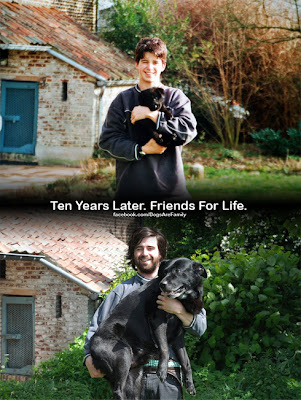
I recently saw this image posted on Facebook and I don’t mind admitting that it tugged at my emotions.
Around the same day, I was watching my two year old toddler (an unpublished and independent kawaii survey reports the toddler is somewhat cute) interacting with my dogs (they are cute, no survey required).
Around the same day, I was watching my two year old toddler (an unpublished and independent kawaii survey reports the toddler is somewhat cute) interacting with my dogs (they are cute, no survey required).
 |
| (source) |
The toddler is currently learning (slowly) that the world is not 100% about the toddler. This involves me frequently coaching the toddler’s interactions with other people and children (“yes it’s very sweet that you love your friend and that you’re giving them a big hug, but now you’ve actually crash-tackled them to the floor and they’re crying, it might be time to give them space”) and more recently in a similar way with the dogs.
These home observations and website images got me thinking about how important my pets, and in particular, my dogs, were to me while growing up.
It got me wondering - why do so many of us have enduring psychological attachment to our childhood dogs?
And do our childhood experiences stay with us as firmly held attitudes into adulthood?
I plan to spend my next posts looking at some of the science surrounding children and dogs: the good, the bad and the ugly.
 |
| (source) |
And do our childhood experiences stay with us as firmly held attitudes into adulthood?
I plan to spend my next posts looking at some of the science surrounding children and dogs: the good, the bad and the ugly.
Why are dogs good for children?
 The biophilia hypothesis suggests that people are instinctively attracted to animals and nature. It proposes that our relationship with them may contribute on an intimate biological level to our sense of fulfilment and identity. In our current busy lifestyles, often lived in industrialised city environments removed from ‘nature’ in its purest form, dogs and other companion animals offer opportunities for these ‘biophilic’ relationships.
 These nurturing relationships with animals are considered particularly important during early and middle childhood. Some research suggests that humans have a higher degree of attachment to dogs than we do to other companion animals; however, this may be a flaw in the way such studies have assessed attachment.

 |
| (source) |
So it seems like there’s a lot to like about fostering a positive relationship between children and dogs. But what happens to children when such an important relationship ends? And do our childhood experiences stay with us into adulthood?
Dont worry - I’ll be sure tell you more about that next time!
Dont worry - I’ll be sure tell you more about that next time!
Mia
p.s. Dont forget to head over to our facebook page to keep track of the childhood dog photo challenge!
p.s. Dont forget to head over to our facebook page to keep track of the childhood dog photo challenge!
Further reading:
OHaire M. (2010). Companion animals and human health: Benefits, challenges, and the road ahead, Journal of Veterinary Behavior: Clinical Applications and Research, 5 (5) 226-234. DOI: 10.1016/j.jveb.2010.02.002
Melson G.F. Child Development and the Human-Companion Animal Bond, American Behavioral Scientist, 47 (1) 31-39. DOI: 10.1177/0002764203255210
Blue G.F. (1986). The Value of Pets in Childrens Lives, Childhood Education, 63 (2) 85-90. DOI: 10.1080/00094056.1986.10521747
Zasloff R.L. (1996). Measuring attachment to companion animals: a dog is not a cat is not a bird, Applied Animal Behaviour Science, 47 (1-2) 43-48. DOI: 10.1016/0168-1591(95)01009-2
Holscher B., Frye C., Wichmann H.E. & Heinrich J. (2002). Exposure to pets and allergies in children, Pediatric Allergy and Immunology, 13 (5) 334-341. DOI: 10.1034/j.1399-3038.2002.02063.x
Anderson K.L. & Olson M.R. (2006). The value of a dog in a classroom of children with severe emotional disorders, Anthrozoos: A Multidisciplinary Journal of The Interactions of People & Animals, 19 (1) 35-49. DOI: 10.2752/089279306785593919
Gee N.R., Harris S.L. & Johnson K.L. (2007). The Role of Therapy Dogs in Speed and Accuracy to Complete Motor Skills Tasks for Preschool Children, Anthrozoos: A Multidisciplinary Journal of The Interactions of People & Animals, 20 (4) 375-386. DOI: 10.2752/089279307X245509
© Mia Cobb 2012


