 |
| Cute or feeding an unrealistic fantasy? (source) |
You raise such an important point!
In the same way that popular culture can influence our perceptions and interpretations of ‘cute’ in domains like body image and kawaii, photos of babies with dogs can set us up with unrealistic expectations that might lead to ugly situations and devastating outcomes.

And it’s some of The Ugly side of the science surrounding children and dogs that I want to share with you today. Dogs can hurt children and children can hurt dogs.
It’s ugly alright.
Dogs biting kids:
As you pointed out in your last post, part of the The Ugly is that dogs can and do bite babies and kids.
 |
| (source) |
The risk factors for being bitten vary a little from study to study (as youd expect given each study looks at a different population), but generally, it’s consistent that the kids most at risk were:
- Aged five years or under (with the 5-10yr age group a close second);
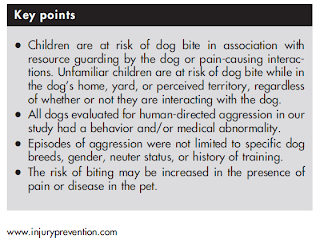
- Attempting to access the dog’s territory or a resource (toy/food/bone, etc.) sometimes with the dog on lead or chained in a yard, or
- Provoking the dog (by stepping on; pulling the dog’s hair/ears; hitting or attempting to ‘discipline’ the dog or waking a sleeping dog);
- At home or in a friend’s/neighbour’s/relative’s house (i.e. a dog known to the child and generally in the dog’s home environment)
- Not directly supervised by an adult.
- Boys appear more likely to be bitten by dogs not from their own households, but boys and girls have been shown to be bitten equally by dogs from their own households.
 |
| From Reisner et al., 2007 (source) |
 |
| (source) |
I emphasise most at risk, as obviously all people are at some risk of being bitten by any dog they encounter.
Dogs involved often have no prior history of biting children, although some have previously bitten adults or other animals.
We don’t know the full story.
Most figures regarding dog bites coming from hospital reports or other health authorities. It’s been calculated that in the USA, over 900 dog bite injuries are treated in hospital emergency departments each day. The same study estimated that for every dog bite fatality; there are approximately 16,000 dog-bite related emergency department visits. Just staggering figures!
 |
| (source) |
And yet, dog bites are most likely under-reported. Not all dog bites get treated at hospital and as such, many cases may go unreported.
A study from the 1980’s demonstrated that nearly half of 3,000 children (aged 4-18) surveyed reported being bitten by a dog in their lifetime.
More than 36 times the rate reported to authorities!
A study from the 1980’s demonstrated that nearly half of 3,000 children (aged 4-18) surveyed reported being bitten by a dog in their lifetime.
More than 36 times the rate reported to authorities!
Identification of the dog breeds involved is probably inaccurate. Dog breed identification for dogs involved in attacks are usually self-reported to health authorities by the victim or victim’s family. Recent research has demonstrated how hard it is for even dog experts to accurately identify dog breeds, so can you see where there might be an issue in the validity of this data?
Why are young kids at such high risk of being bitten?
 |
| (source) |
 |
| "My, what big teeth you have..." |
Kids abusing dogs:
The notion of children deliberately inflicting pain or suffering on dogs and other animals is distressing.
But it happens.
But it happens.
A symptom of other problems
Children who abuse animals are reportedly twice as likely to have experienced sexual or physical abuse themselves compared to children who are not cruel to animals.
They often come from households of domestic/family violence.
They often experience parental alcoholism/unavailablility.
Violent behaviour is believed to be learned by these children as a viable tool in relationships (i.e. this is how you relate to others) and/or is modelled from adult behaviour they have directly observed.
Exerting ‘power’ over an animal may also assist children who feel otherwise powerless in such situations of family violence.
They often come from households of domestic/family violence.
They often experience parental alcoholism/unavailablility.
 |
| (source) |
Violent behaviour is believed to be learned by these children as a viable tool in relationships (i.e. this is how you relate to others) and/or is modelled from adult behaviour they have directly observed.
Exerting ‘power’ over an animal may also assist children who feel otherwise powerless in such situations of family violence.
Its incredibly sad. For everyone. The children and the dogs.
 |
| (source) |
- displaced hostility against a person to an animal;
- expression of aggression;
- post-traumatic play; and
- to hurt someone else by hurting a animals (using the animal as a vehicle for emotional abuse).
Animal abuse as a child lead to..?
Research has demonstrated associations between acts of childhood cruelty to animals and acts of serious, recurrent, interpersonal aggression/violence and other generalised anti-social behaviours as adults.
Although it is tempting to suggest that animal cruelty exhibited in childhood leads to interpersonal violence in adulthood, it is considered a better conclusion that childhood home environment is a strong predictor of the development of many violent behaviours, often clustered together.
 |
| (source) |
Childhood experiences into adulthood:
Most fearful adults report their fear of dogs began in childhood. However, being attacked as a child doesn’t necessarily mean you will be fearful of dogs as an adult.
Most adults are dog-fearful following a direct experience of dog bite rather than being influenced by an attack event that happened to someone they knew or from verbal information/education passed to them by others.
Amazingly, being bitten as a child has not been associated with a dislike of dogs. Positive experiences with dogs prior to being bitten made children less likely to become dog-phobic adults. It’s not fully understood why some children can recover and others retain their fearfulness into adulthood, sometimes even suffering ongoing PTSD.
Most adults are dog-fearful following a direct experience of dog bite rather than being influenced by an attack event that happened to someone they knew or from verbal information/education passed to them by others.
Amazingly, being bitten as a child has not been associated with a dislike of dogs. Positive experiences with dogs prior to being bitten made children less likely to become dog-phobic adults. It’s not fully understood why some children can recover and others retain their fearfulness into adulthood, sometimes even suffering ongoing PTSD.
 |
| (source) |
It’s The Good shining through, even in the face of The Ugly!
So there you have it Julie.
Some of the science surrounding children and dogs: the good, the bad and the ugly.
I’m really hoping you can tell me about something fun and frivolous in your next post!
Mia
 |
| What hasnt been in any other image Ive used in these three posts? Parental supervision! (source) |
Further reading:
Meints K., Allen K. & Watson C. (2011). Atypical face-scan patterns in children misinterpreting dogs facial expressions evidence from eye-tracking, Injury Prevention, 16 (Supplement 1) A173-A173. DOI: 10.1136/ip.2010.029215.619
Shewell P.C. & Nancarrow J.D. (1991). Dogs that bite., BMJ, 303 (6816) 1512-1513. DOI: 10.1136/bmj.303.6816.1512
Reisner I.R., Shofer F.S. & Nance M.L. (2007). Behavioral assessment of child-directed canine aggression, Injury Prevention, 13 (5) 348-351. DOI: 10.1136/ip.2007.015396
Weiss H.B. Incidence of Dog Bite Injuries Treated in Emergency Departments, JAMA: The Journal of the American Medical Association, 279 (1) 51-53. DOI: 10.1001/jama.279.1.51
Ozanne-Smith J., Ashby K. & Stathakis V.Z. (2001). Dog bite and injury prevention--a

Selasa, 12 April 2016
Dog Training Clicker

Clicker Dog Training
The newest dog training craze is clicker dog training. A clicker is a small rectangular plastic box with a metal button on top that clicks, hence the name clicker. It’s the type of training that the dog decides whether or not it suits him. There have been a lot of success stories with clickers, but with my dog he just didn’t want to know!
Researchers in dog studies believe that the clicker promotes enforced training, without punishment! As we all know when we do something good and get rewarded for it we are going to do the same again, a dog thinks the same way. Dogs learn through consequences, if they do something and it earns them a treat and praise they are going to want to do it again because they like this consequence. If they do something that you don’t like and they get ignored or said no to in a strict voice they know that they aren’t going to get any treats so are not going to do it again.
Clicker dog training works in such a way it reinforces good behaviour. If your dog sits, click and give him a treat. The next time he sits do the same but don’t say anything to him. He will soon realise that when he sits he will get a treat and hear a click, so when you eventually come to click before he sits he knows to sit. Its not all that confusing when you think about it.
Punishment is not used with clicker dog training as researchers believe that although punishment does stop some bad behaviour it may also create another unwanted behaviour. Punishment is almost always carried out after the dog has done something wrong so dogs see punishment as a random consequence therefore punishment doesn’t really solve anything.
Clicker dog training is not only used or dogs! It is widely used for other animals such as dolphins and horses. It is a widely practiced training method and does produce results; if carried out properly.
Some of the best quality dog resources and articles can be found online at MDarmas Dog Site. Our visitors recommend this website each time they try to search for dog training tips, advice and insider secrets from experts. You can search thru the form by keywords on that site or just browse their library of dog-related articles by experts in various fields of american eskimo breed dog.
Cheers
MDarma


.jpg)

